Assistant Professor of Computational Social Science · University of Konstanz
My work sits at the intersection of computational social science and economics. I study how
people and algorithms make collective decisions. Previously a postdoc at ETH Zürich
(with Dirk Helbing) and at Caltech (with Colin Camerer).
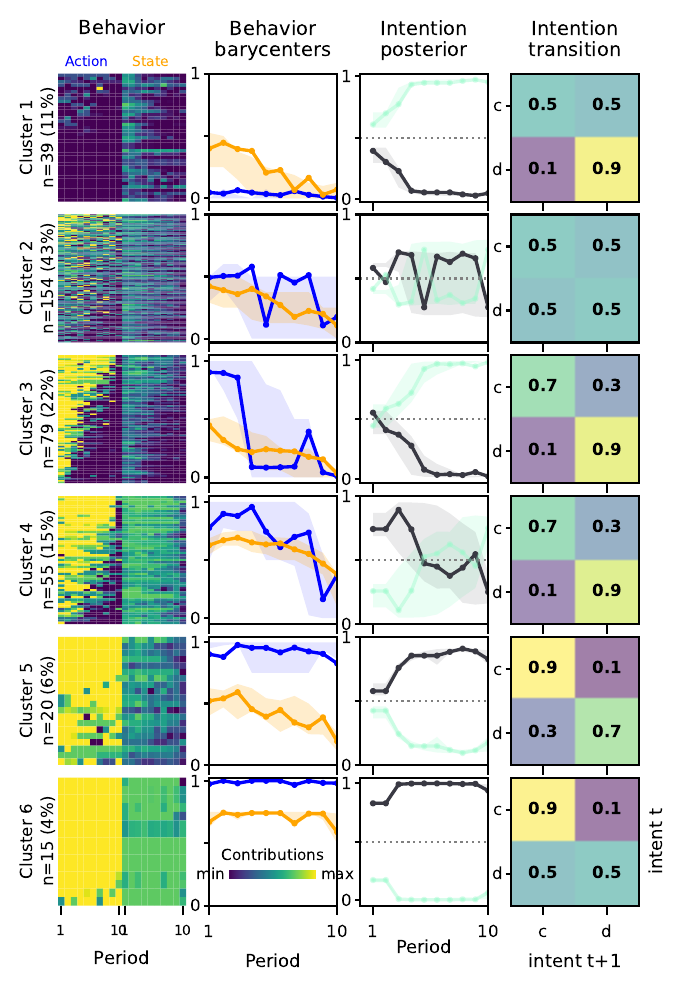
Behavior in repeated public goods games continues to challenge standard theory: heterogeneous social preferences can explain first-round contributions, but not the substantial volatility observed across repeated interactions. Using 50,390 decisions from 2,938 participants, we introduce two methodological advances to address this gap. First, we cluster behavioral trajectories by their temporal shape using Dynamic Time Warping, yielding distinct and theoretically interpretable behavioral types. Second, we apply a hierarchical inverse Q-learning framework that models decisions as discrete switches between latent cooperative and defective intentions. This approach reveals a large (21.4%) and previously unmodeled behavioral type — Switchers — who frequently reverse intentions rather than commit to stable strategies. At the same time, the framework recovers canonical strategic behaviors such as persistent cooperation and free-riding. Substantively, recognizing intentional volatility helps sustain cooperation: brief defections by Switchers often reverse, so strategic patience can prevent unnecessary breakdowns.
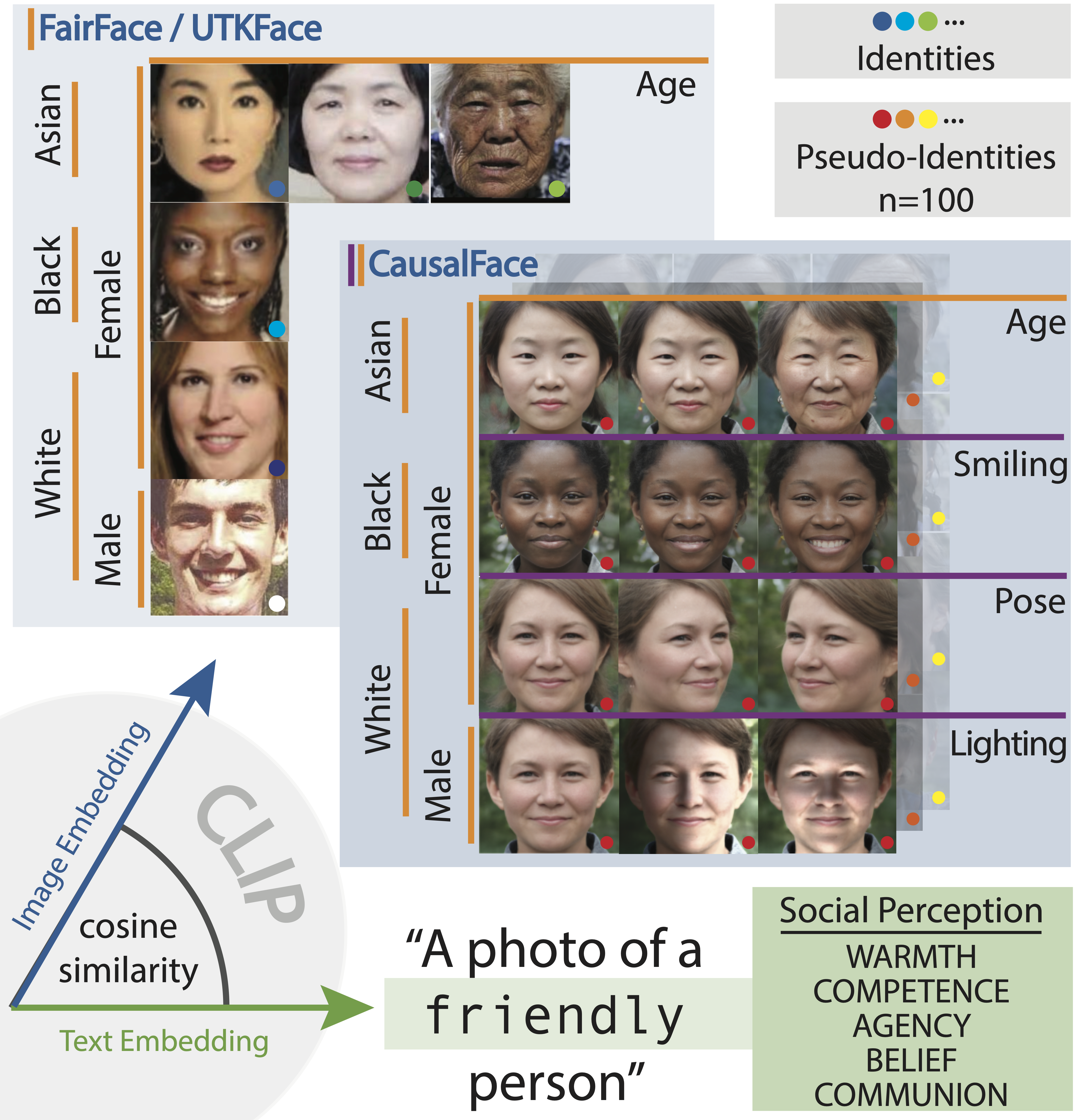
We explore social perception of human faces in CLIP, a widely used open-source vision-language model. To this end, we compare the similarity in CLIP embeddings between different textual prompts and a set of face images. Our textual prompts are constructed from well-validated social psychology terms denoting social perception. The face images are synthetic and are systematically and independently varied along six dimensions: the legally protected attributes of age, gender, and race, as well as facial expression, lighting, and pose. Independently and systematically manipulating face attributes allows us to study the effect of each on social perception and avoids confounds that can occur in wild-collected data due to uncontrolled systematic correlations between attributes. Thus, our findings are experimental rather than observational. Our main findings are three. First, while CLIP is trained on the widest variety of images and texts, it is able to make fine-grained human-like social judgments on face images. Second, age, gender, and race do systematically impact CLIP's social perception of faces, suggesting an undesirable bias in CLIP vis-a-vis legally protected attributes. Most strikingly, we find a strong pattern of bias concerning the faces of Black women, where CLIP produces extreme values of social perception across different ages and facial expressions. Third, facial expression impacts social perception more than age and lighting as much as age. The last finding predicts that studies that do not control for unprotected visual attributes may reach the wrong conclusions on bias. Our novel method of investigation, which is founded on the social psychology literature and on the experiments involving the manipulation of individual attributes, yields sharper and more reliable observations than previous observational methods and may be applied to study biases in any vision-language model.
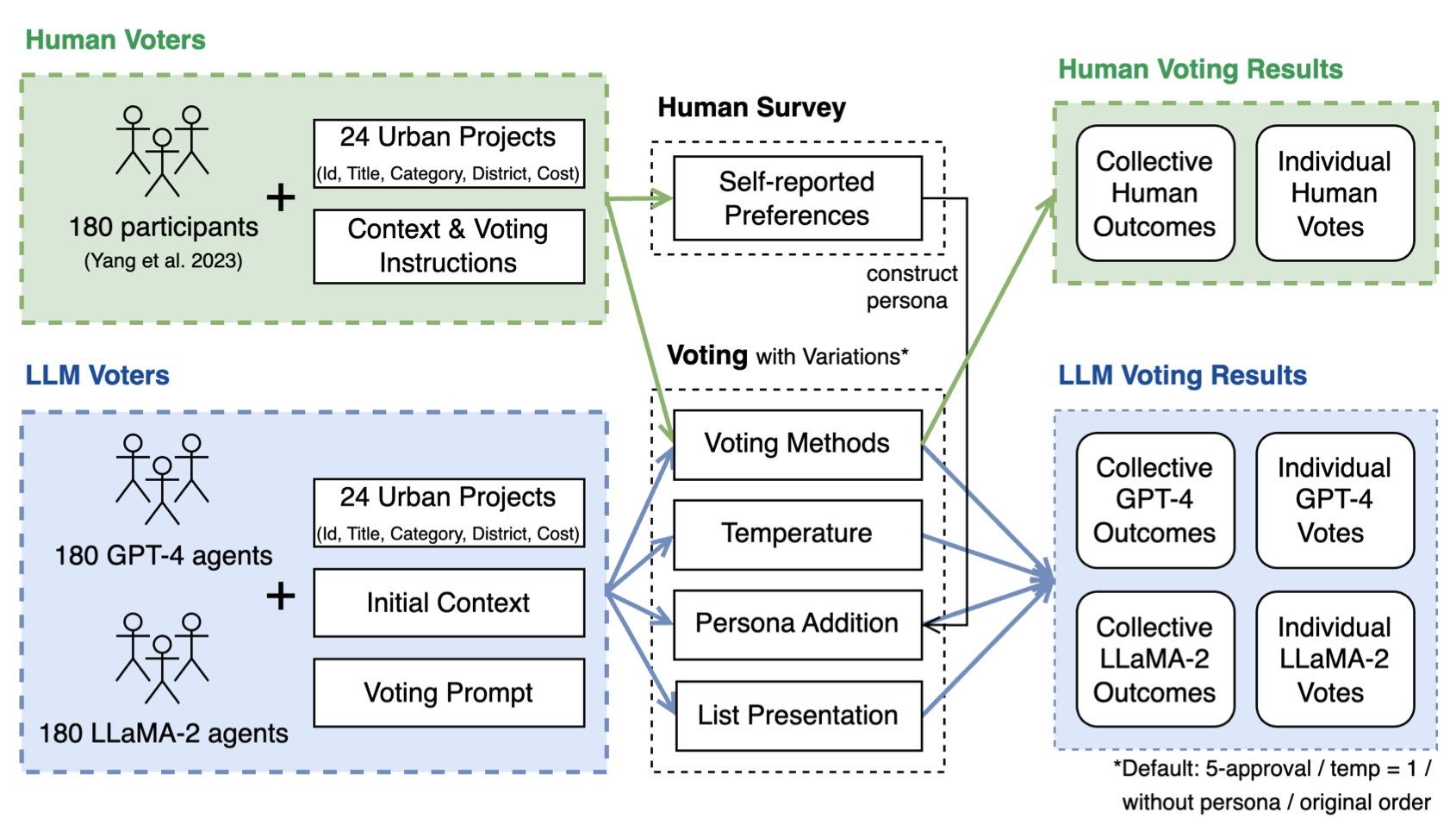
This paper investigates the voting behaviors of Large Language Models (LLMs), specifically GPT-4 and LLaMA-2, their biases, and how they align with human voting patterns. Our methodology involved using a dataset from a human voting experiment to establish a baseline for human preferences and conducting a corresponding experiment with LLM agents. We observed that the choice of voting methods and the presentation order influenced LLM voting outcomes. We found that varying the persona can reduce some of these biases and enhance alignment with human choices. While the Chain-of-Thought approach did not improve prediction accuracy, it has potential for AI explainability in the voting process. We also identified a trade-off between preference diversity and alignment accuracy in LLMs, influenced by different temperature settings. Our findings indicate that LLMs may lead to less diverse collective outcomes and biased assumptions when used in voting scenarios, emphasizing the need for cautious integration of LLMs into democratic processes.
C. I. Hausladen*, M. Gallo*, M. Hsu, A. C. Jenkins, V. Ona, C. F. Camerer
PLoS ONE · 2024 · * equal contribution
Cited by 7
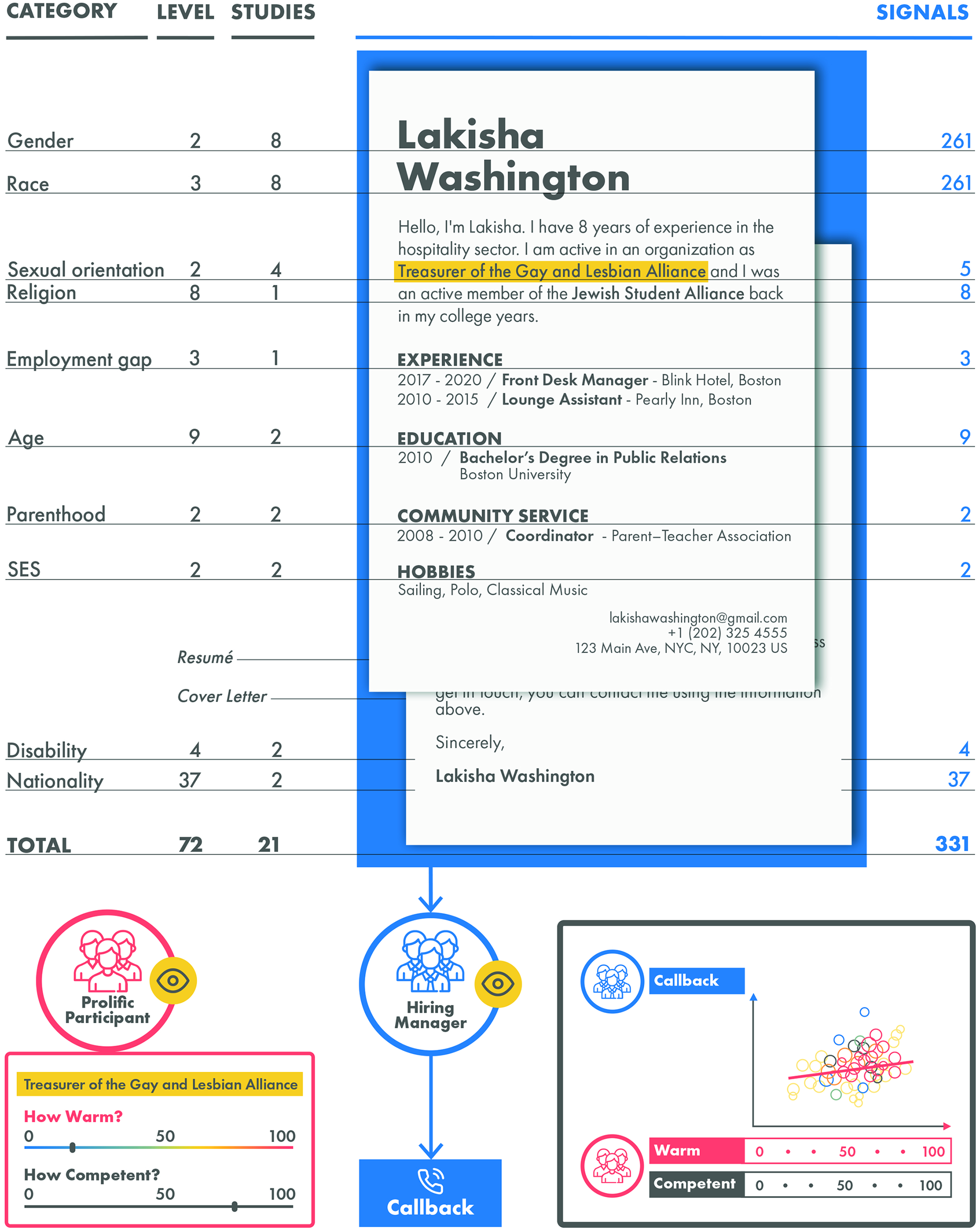
Extensive literature probes labor market discrimination through correspondence studies in which researchers send pairs of resumes to employers, which are closely matched except for social signals such as gender or ethnicity. Upon perceiving these signals, individuals quickly activate associated stereotypes. The Stereotype Content Model (SCM; Fiske 2002) categorizes these stereotypes into two dimensions: warmth and competence. Our research integrates findings from correspondence studies with theories of social psychology, asking: Can discrimination between social groups, measured through employer callback disparities, be predicted by warmth and competence perceptions of social signals? We collect callback rates from 21 published correspondence studies, varying for 592 social signals. On those social signals, we collected warmth and competence perceptions from an independent group of online raters. We found that social perception predicts callback disparities for studies varying race and gender, which are indirectly signaled by names on these resumes. Yet, for studies adjusting other categories like sexuality and disability, the influence of social perception on callbacks is inconsistent. For instance, a more favorable perception of signals like parenthood does not consistently lead to increased callbacks, underscoring the necessity for further research. Our research offers pivotal strategies to address labor market discrimination in practice. Leveraging the warmth and competence framework allows for the predictive identification of bias against specific groups without extensive correspondence studies. By distilling hiring discrimination into these two dimensions, we not only facilitate the development of decision support systems for hiring managers but also equip computer scientists with a foundational framework for debiasing Large Language Models and other methods that are increasingly employed in hiring processes.
A. Brodeur, D. Valenta, A. Marcoci, … C. I. Hausladen, et al.
Proceedings of the National Academy of Sciences (PNAS) · 2026
Cited by 1
Large Language Models (LLMs) such as ChatGPT are transforming how scientists conduct and validate research, offering promise as tools to improve scientific reproducibility. However, computational reproducibility and error detection remain expensive and labor-intensive. We experimentally test how collaboration between researchers and LLM assistants influences the reproduction of quantitative social science findings across different levels of AI autonomy. We randomly assigned 288 researchers to 103 teams working under three conditions: human-only, AI-assisted (using ChatGPT as a collaborative tool), or AI-led (ChatGPT operating with minimal human oversight). Teams reproduced published results from leading social science journals, detected coding errors, and proposed robustness checks. Human-only and AI-assisted teams achieved comparable reproduction rates (94% vs. 91%) and performed similarly on most outcomes, except human-only teams identified significantly more major coding errors. Both substantially outperformed AI-led teams, which achieved only a 37% reproduction rate, detected fewer errors across all categories, proposed weaker robustness checks, and required more time. This autonomous approach, however, likely represents only a lower bound of AI capabilities. Despite rapid model advances, expert human judgment currently remains indispensable for reliable empirical verification. While AI assistance did not degrade most outcomes, it provided no measurable advantages and was associated with reduced detection of major errors. However, the 37% autonomous reproduction rate indicates that AI could provide value in settings where scale or cost constraints preclude human review of papers, even though general-purpose LLMs offer no immediate advantages for human-supervised verification.
A. Brodeur, D. Mikola, N. Cook, … C. I. Hausladen, et al.
Nature · 2026
Cited by 17
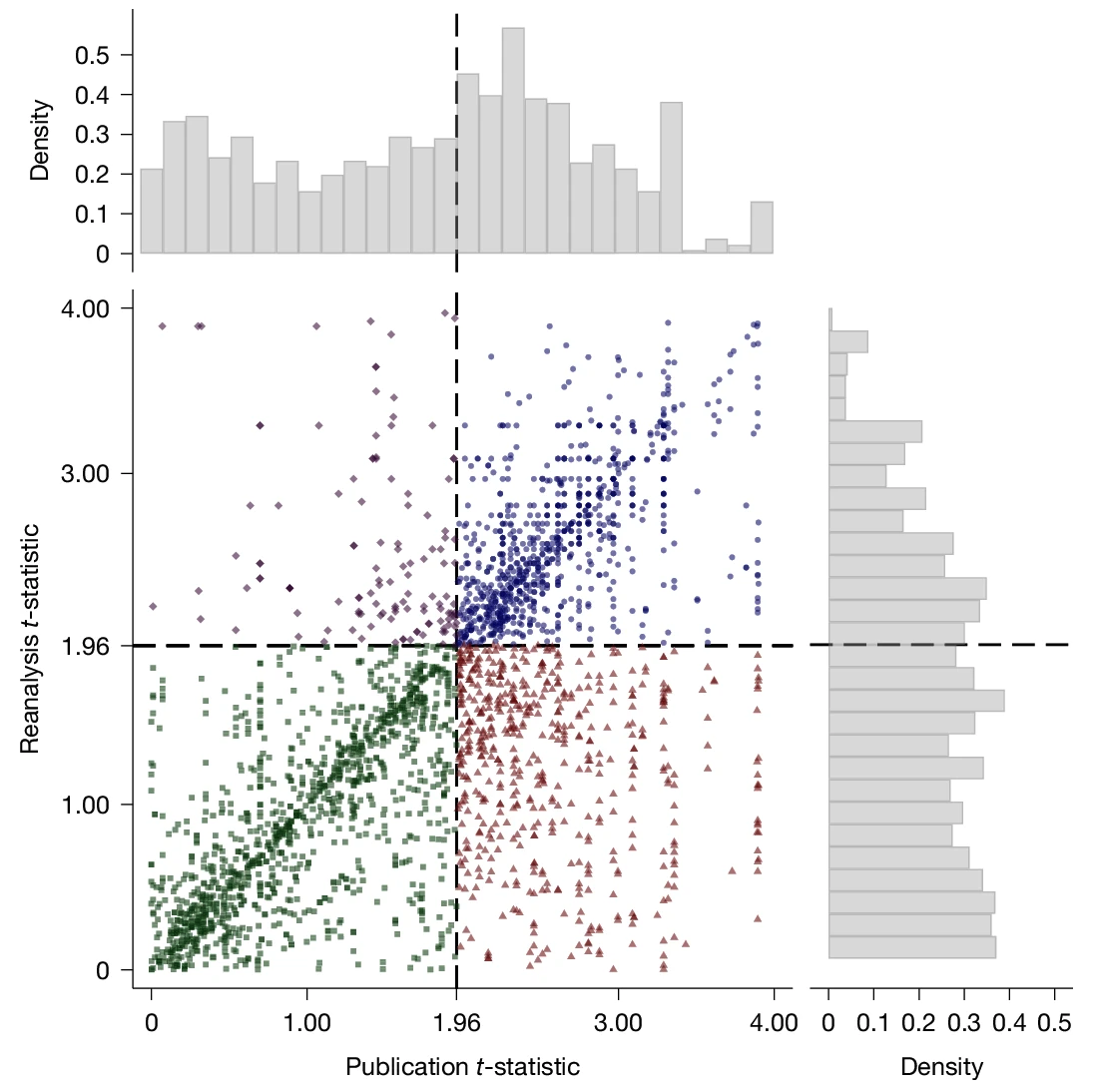
Science aspires to be cumulative. Reproducibility efforts strengthen science by testing the reliability of published findings, promoting self-correction, and informing policy-making. Computational reproductions, whereby independent researchers reproduce the results of published studies, are an essential diagnostic tool. Such efforts should have greater visibility. However, little social science reproduction and robustness has been conducted at scale. Here we reproduced original analyses and conducted robustness checks of 110 articles that were published in leading economics and political science journals with mandatory data and code sharing policies. We found that more than 85% of published claims were computationally reproducible. In robustness checks, our reanalyses showed that 72% of statistically significant estimates remain significant and in the same direction, and the median reproduced effect size is nearly the same as the originally published effect size (that is, 99% of the published effect size). Additionally, 6 independent research teams examined 12 pre-specified hypotheses about determinants of robustness. Research teams with more experience found lower levels of robustness, and robustness did not correlate with author characteristics or data availability.
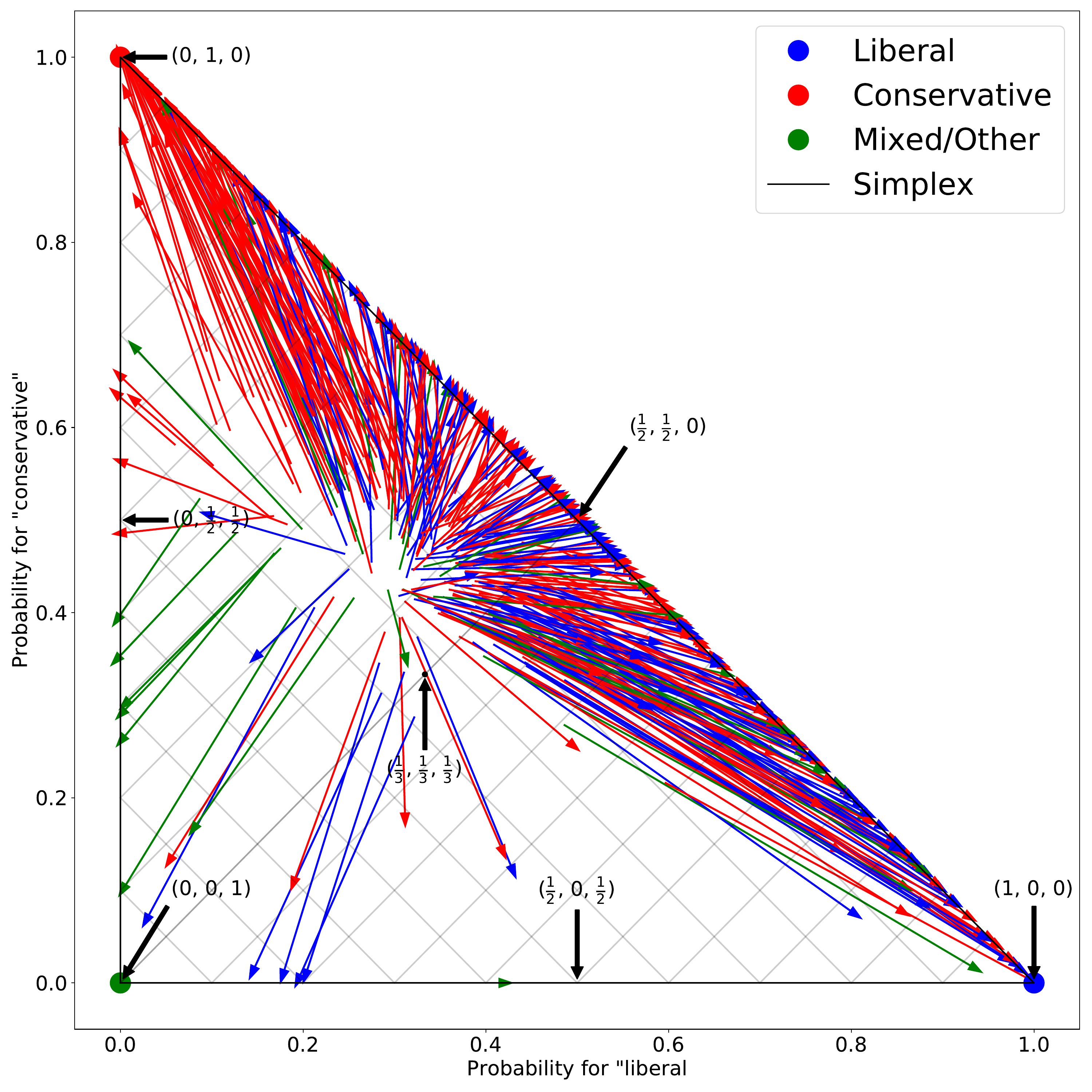
This paper draws on machine learning methods for text classification to predict the ideological direction of decisions from the associated text. Using a 5% hand-coded sample of cases from U.S. Circuit Courts, we explore and evaluate a variety of machine classifiers to predict "conservative decision" or "liberal decision" in held-out data. Our best classifier is highly predictive (F1 = .65) and allows us to extrapolate ideological direction to the full sample. We then use these predictions to replicate and extend Landes and Posner's (2009) analysis of how the party of the nominating president influences circuit judge's votes.